
St. Thomas of Hereford RC Church, Weobley
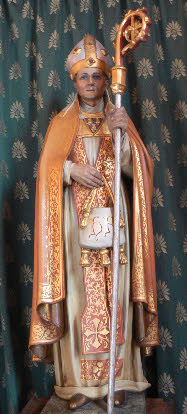 St. Thomas of Hereford is the oldest Catholic church in Herefordshire, consecrated in 1834, thanks to the generosity of the Monnington family of Sarnesfield Court. Its plain, chapel-like exterior was so designed to avoid attracting hostile attention at a time when Catholicism was still regarded with suspicion by many English people.
The church is dedicated to St. Thomas Cantilupe, Bishop of Hereford 1275-1282. It is the centre of a widely-scattered rural parish, containing forty villages and covering some 330 square miles of north-west Herefordshire. Benedictine monks of Belmont Abbey serve the parish.
Thomas belonged to a politically prominent and noble Norman family and was born at Hambledon in Buckinghamshire circa 1218. He was ordained circa 1245 and made a career in Canon Law, lecturing at the Universities of Paris and Oxford. His lawyer’s training and innate hatred of injustice led to an involvement in politics. He was the Barons’ spokesman in their rebellion against Henry III and was named Chancellor of England by Simon de Montfort. Thomas was dismissed and exiled when de Montfort was killed at the Battle of Evesham. In 1273 he returned to England and was appointed Doctor of Divinity and, for the second time, elected Chancellor of Oxford University.
In 1275, Thomas was appointed Bishop of Hereford and set about defending the rights of the diocese against the encroachments of both fellow bishops and lay lords. His combative approach made him many enemies. He insisted on a high standard of discipline and pastoral ministry from his priests but was loved by the common people for his large-heartedness and holy life.
Thomas also fell foul of John Peckham, Archbishop of Canterbury, for his defence of the rights of individual bishops against their archbishop and Peckham excommunicated him. Thomas set off for Rome in 1282 to put his case before Pope Martin IV but died on the journey near Orvieto.
Rome eventually found in his favour. His heart and bones were returned to Hereford Cathedral, where many miraculous cures were reported at his shrine. He was canonised in 1320, and is the only canonised saint to have been excommunicate at the time of his death.